Artgasm
Friday night I spend my time in the American and Modern sections.
And that's where Jackson Pollock happened to me.

I've always loved art. I've loved making it, I've loved looking at it. I got my first real art supplies when I was about seven, a professional pen and ink set, and several college level books detailing techniques for line ink drawing. I devoured them.
In college, I took several art classes, and in my senior year an art history class, Women Artists Since 1940. It was my first official "survey" art course, and I chose it with trepidation but at the encouragement of my academic advisor, who felt it would work doubletime to satisfy both my English and Women's Studies requirements for my major. The class was taught by a sour, unpleasant woman named Thalia Gouma Peterson, who believed noone was as smart as her and who, despite being an avowed feminist, actually hated women. In the first week of class, she informed us that we would be keeping a semester long journal in which we were to choose six paintings from the coursework a week and journal about them. Never having taken an art history class before, I wasn't really sure what "journal about them" meant, and I raised my hand and asked for clarification. Did she want us to talk about how we felt looking at them? About the composition...color, tone, texture, mechanics? About what critics said? Was there a form for this type of writing, or was this to be a more organic process? She looked at me with contempt and informed me that journaling meant journaling. That first week, I fretted about what to do. I knew what I liked, how my tastes ran, and we had been introduced to several works that I had strong reactions to, but I had no idea what was expected of me in terms of how to talk about art. I ended up writing about my reactions to the paintings, their tone and how they made me feel.
That was apparently not what she had in mind. The following week when she handed the journals back, I opened mine to find a big red "F", and a scrawled note reading I can't believe you're a senior English major!
So began an ugly semester between the two of us. My efforts to better understand her expectations of me only fueled her belief that I was just trying to "get over" in the class, which only fueled my anger at her anti-feminist approach to teaching and to women in general. I ended up failing the class. I appealed the F and won, and she ended up begrudginly passing me with a "C".
Since then, I've always been a little bit intimidated by the "art world." Again, I know my taste, and I'm confident in my ability to do things like decorate my home, or create household art, but I've shied away from talking about art with people who are artists or art critics. I'm able to enjoy looking at art, I love going to the Met, but I've never had that really intimate, personal and gut punching reaction to a piece. I've never just been floored, in any kind of emotional way. Usually it's more about appreciating the work of a specific artist in the context of their life condition or struggle.
This weekend I saw my first Jackson Pollock painting in person. I've seen poster reproductions of his work, and I've seen reproductions in art books and documentaries. But never the real deal. And I've never felt particularly drawn to abstract art.
Imagine my suprise, then, when I turned a corner in the modern gallery and came face to face with Jackson Pollock's Autumn Rhythm (Number 30) and couldn't walk away.
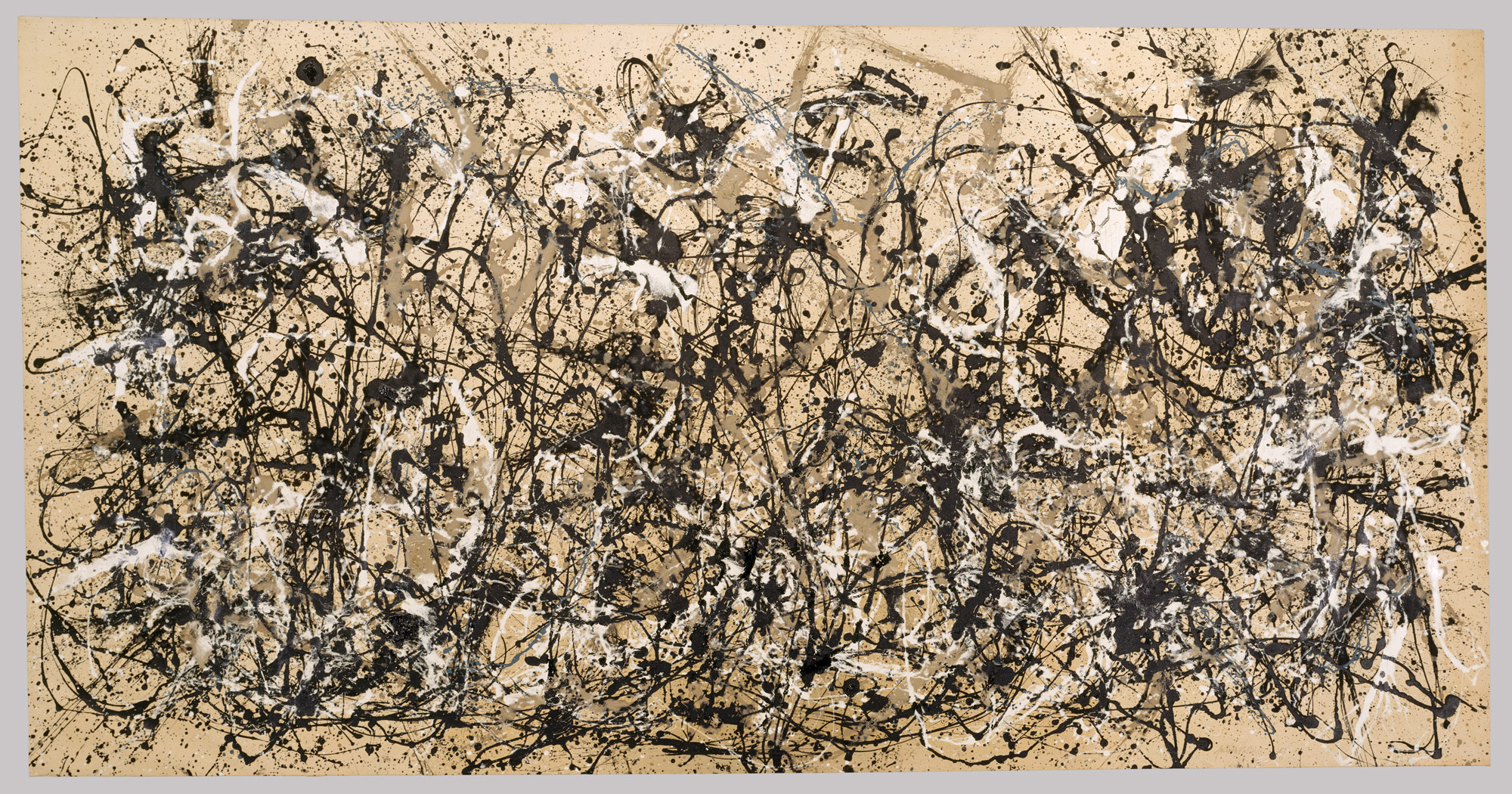
It was bigger than me, and it had a depth that I felt like I literally sank into. It had a kind of energy that was mesmerizing, and I found myself staring and staring, trying to find a methodology, trying to find a starting point among the layers and layers of paint drips. I've looked at his drip works before and flippantly thought to myself that they didn't seem particularly "planned," that they were random and chaotic and easily reproduced. I was completely wrong. The longer I stood there and stared, the more entreched I got, and patterns started to emerge, and my eyes were travelling and travelling the canvas without stopping. It was alive. I sat down in front of it and just stared, and felt this warmth come over me, this joy. No kidding. It was like suddenly I just "got it." I got what people talked about when they talked about art that was transformative, that was emotional and intimate. I had my first artgasm, right there in the Met in front of 20 other people speeding through the galleries with no idea what I was seeing. I was awestruck. I used to be one of them.
I sat there for 45 minutes. I started to feel this protectiveness of the painting. I felt myself inwardly flinching as people walked by and commented that it was nothing, that they could do the same thing on their garage wall. I wasn't really interested in seeing anything else that night; I was afraid to walk away from it, afraid when I came back to see it again I wouldn't see it like I was seeing it in that moment, that it's power would be lost.
After a little while, the gallery security attendant walked over to me. He apologized for interrupting me, told me he wasn't supposed to talk to patrons but he couldn't help but see my reaction to the painting. He had a thick Jamaican accent and I had to strain to hear him, but I was curious as to what he wanted. I nodded that it was okay, and he proceeded to tell me a story of a man he saw one day who came in and sat on the very bench I was sitting on, staring at the painting. He told me the man sat for six hours, six hours, and at the end of the day he stood up, he shook his head, shrugged and walked away. The guard told me he didn't know what it was that man had been looking for, but that he didn't think he found it. He told me I had that same look in my eye, and told me the painting was very intriguing to many people.
I still sat, looking. I do think the man found what he was looking for.
I certainly did. Without even realizing that I had been searching. Hello existentialism, I didn't know I had you in me.
When I got home, I researched a bit about Jackson Pollock. I found out that he believed that art was more than representations of familiar forms. He thought people used lines to create boundaries, to define shapes and space and enclosures, and he sought to free lines from definition and expose them as independently beautiful. When he painted, he stretched great pieces of canvas across the floor of his studio. He said "On the floor I am more at ease. I feel nearer, more part of the painting, since this way I can walk around it, work from the four sides and literally be in the painting." He didn't work with a brush, he used his hands, he used sticks and sometimes poured paint right out of the can to drip and spatter paint against the canvas in layers on layers. This was known as his "drip" period, between 1946 and 1950. Eventually, as his work gained more notariety he began feeling pressure from gallery owners to return to a more structured, traditional "form" representation in his paintings. He stopped doing drip works, and began drinking. In 1953 he stopped painting all together, unable to resolve his creative inspirations with the work he created to please the public and gallery owners. He died in 1956 in an alcohol related car crash, at the age of 44. People call his style of painting "action painting," and say he gave birth to the movement.
I was fortunate enough to find a video of him in action on youtube. It doesn't come near representing the actual wonderment of seeing his work in person. Neither does the reproduction I included above do it justice. If you really want to know, you'll just have to come to New York and visit the Met for yourself. I'll even put you up.
In the meantime, I've acquired a list of the locations of all 26 of his drip pieces. You can guess how I'll be spending my spring.
¶ 8:20 PM

Sunday, February 11, 2007
I went to the Met this weekend (that's the Metropolitan Museum of Art, for those Non New Yorkers among us). I love going, and now that I'm older I've taken to restricting myself when I go, vowing to spend my time not trying to rush through a whirlwind overview of the entire collection, but to devote my time to one wing, to spend three, sometimes four hours just absorbing a small portion, taking time to read the cards and stories behind the work, to see the tiniest brushstrokes over a glancing appreciation.Friday night I spend my time in the American and Modern sections.
And that's where Jackson Pollock happened to me.
I've always loved art. I've loved making it, I've loved looking at it. I got my first real art supplies when I was about seven, a professional pen and ink set, and several college level books detailing techniques for line ink drawing. I devoured them.
In college, I took several art classes, and in my senior year an art history class, Women Artists Since 1940. It was my first official "survey" art course, and I chose it with trepidation but at the encouragement of my academic advisor, who felt it would work doubletime to satisfy both my English and Women's Studies requirements for my major. The class was taught by a sour, unpleasant woman named Thalia Gouma Peterson, who believed noone was as smart as her and who, despite being an avowed feminist, actually hated women. In the first week of class, she informed us that we would be keeping a semester long journal in which we were to choose six paintings from the coursework a week and journal about them. Never having taken an art history class before, I wasn't really sure what "journal about them" meant, and I raised my hand and asked for clarification. Did she want us to talk about how we felt looking at them? About the composition...color, tone, texture, mechanics? About what critics said? Was there a form for this type of writing, or was this to be a more organic process? She looked at me with contempt and informed me that journaling meant journaling. That first week, I fretted about what to do. I knew what I liked, how my tastes ran, and we had been introduced to several works that I had strong reactions to, but I had no idea what was expected of me in terms of how to talk about art. I ended up writing about my reactions to the paintings, their tone and how they made me feel.
That was apparently not what she had in mind. The following week when she handed the journals back, I opened mine to find a big red "F", and a scrawled note reading I can't believe you're a senior English major!
So began an ugly semester between the two of us. My efforts to better understand her expectations of me only fueled her belief that I was just trying to "get over" in the class, which only fueled my anger at her anti-feminist approach to teaching and to women in general. I ended up failing the class. I appealed the F and won, and she ended up begrudginly passing me with a "C".
Since then, I've always been a little bit intimidated by the "art world." Again, I know my taste, and I'm confident in my ability to do things like decorate my home, or create household art, but I've shied away from talking about art with people who are artists or art critics. I'm able to enjoy looking at art, I love going to the Met, but I've never had that really intimate, personal and gut punching reaction to a piece. I've never just been floored, in any kind of emotional way. Usually it's more about appreciating the work of a specific artist in the context of their life condition or struggle.
This weekend I saw my first Jackson Pollock painting in person. I've seen poster reproductions of his work, and I've seen reproductions in art books and documentaries. But never the real deal. And I've never felt particularly drawn to abstract art.
Imagine my suprise, then, when I turned a corner in the modern gallery and came face to face with Jackson Pollock's Autumn Rhythm (Number 30) and couldn't walk away.
It was bigger than me, and it had a depth that I felt like I literally sank into. It had a kind of energy that was mesmerizing, and I found myself staring and staring, trying to find a methodology, trying to find a starting point among the layers and layers of paint drips. I've looked at his drip works before and flippantly thought to myself that they didn't seem particularly "planned," that they were random and chaotic and easily reproduced. I was completely wrong. The longer I stood there and stared, the more entreched I got, and patterns started to emerge, and my eyes were travelling and travelling the canvas without stopping. It was alive. I sat down in front of it and just stared, and felt this warmth come over me, this joy. No kidding. It was like suddenly I just "got it." I got what people talked about when they talked about art that was transformative, that was emotional and intimate. I had my first artgasm, right there in the Met in front of 20 other people speeding through the galleries with no idea what I was seeing. I was awestruck. I used to be one of them.
I sat there for 45 minutes. I started to feel this protectiveness of the painting. I felt myself inwardly flinching as people walked by and commented that it was nothing, that they could do the same thing on their garage wall. I wasn't really interested in seeing anything else that night; I was afraid to walk away from it, afraid when I came back to see it again I wouldn't see it like I was seeing it in that moment, that it's power would be lost.
After a little while, the gallery security attendant walked over to me. He apologized for interrupting me, told me he wasn't supposed to talk to patrons but he couldn't help but see my reaction to the painting. He had a thick Jamaican accent and I had to strain to hear him, but I was curious as to what he wanted. I nodded that it was okay, and he proceeded to tell me a story of a man he saw one day who came in and sat on the very bench I was sitting on, staring at the painting. He told me the man sat for six hours, six hours, and at the end of the day he stood up, he shook his head, shrugged and walked away. The guard told me he didn't know what it was that man had been looking for, but that he didn't think he found it. He told me I had that same look in my eye, and told me the painting was very intriguing to many people.
I still sat, looking. I do think the man found what he was looking for.
I certainly did. Without even realizing that I had been searching. Hello existentialism, I didn't know I had you in me.
When I got home, I researched a bit about Jackson Pollock. I found out that he believed that art was more than representations of familiar forms. He thought people used lines to create boundaries, to define shapes and space and enclosures, and he sought to free lines from definition and expose them as independently beautiful. When he painted, he stretched great pieces of canvas across the floor of his studio. He said "On the floor I am more at ease. I feel nearer, more part of the painting, since this way I can walk around it, work from the four sides and literally be in the painting." He didn't work with a brush, he used his hands, he used sticks and sometimes poured paint right out of the can to drip and spatter paint against the canvas in layers on layers. This was known as his "drip" period, between 1946 and 1950. Eventually, as his work gained more notariety he began feeling pressure from gallery owners to return to a more structured, traditional "form" representation in his paintings. He stopped doing drip works, and began drinking. In 1953 he stopped painting all together, unable to resolve his creative inspirations with the work he created to please the public and gallery owners. He died in 1956 in an alcohol related car crash, at the age of 44. People call his style of painting "action painting," and say he gave birth to the movement.
I was fortunate enough to find a video of him in action on youtube. It doesn't come near representing the actual wonderment of seeing his work in person. Neither does the reproduction I included above do it justice. If you really want to know, you'll just have to come to New York and visit the Met for yourself. I'll even put you up.
In the meantime, I've acquired a list of the locations of all 26 of his drip pieces. You can guess how I'll be spending my spring.
¶ 8:20 PM
